FauxPy Documentation






What is FauxPy?
FauxPy (pronounced: foh pie) is an automated fault localization tool for Python programs.
It helps developers locate the root cause of software bugs using advanced dynamic analysis techniques.
FauxPy is open-source and available on GitHub.
This documentation provides installation steps, usage instructions, and API details.
New in FauxPy: LLM-Driven MBFL 🚀
FauxPy now supports LLM-Driven Mutation-Based Fault
Localization!
This functionality is the result of
integrating PyLLMut
into FauxPy.
Check out
Example 2 on the Quick Start page
to see this new feature in action.
Feedback
Help improve FauxPy! Share your feedback in our Discussions.
Features
FauxPy supports seven classic fault localization techniques in four families:
- SBFL (spectrum-based) techniques Tarantula, Ochiai, and DStar.
- MBFL (mutation-based) techniques Metallaxis and Muse.
- PS (predicate switching) fault localization.
- ST (stack-trace) fault localization.
It supports fault localization at the level of statements (statement-level granularity) and at the level of functions (function-level granularity).
FauxPy is based on dynamic analysis, and works seamlessly with tests written in:
FauxPy can also leverage large language models (LLMs) to improve fault localization effectiveness.
FauxPy in Action
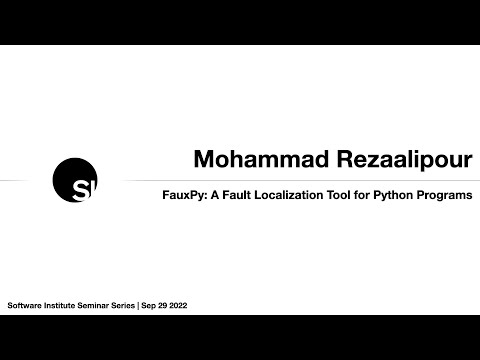
Watch this demo video to see FauxPy in action!
It covers:
- Running FauxPy on real-world Python projects
- Interpreting fault localization results
- Best practices for debugging with FauxPy

Explore the Documentation
- User Guide – Learn how to install and use FauxPy effectively.
- API Reference – Documentation of FauxPy’s main entry point and the two core classes that handle execution.